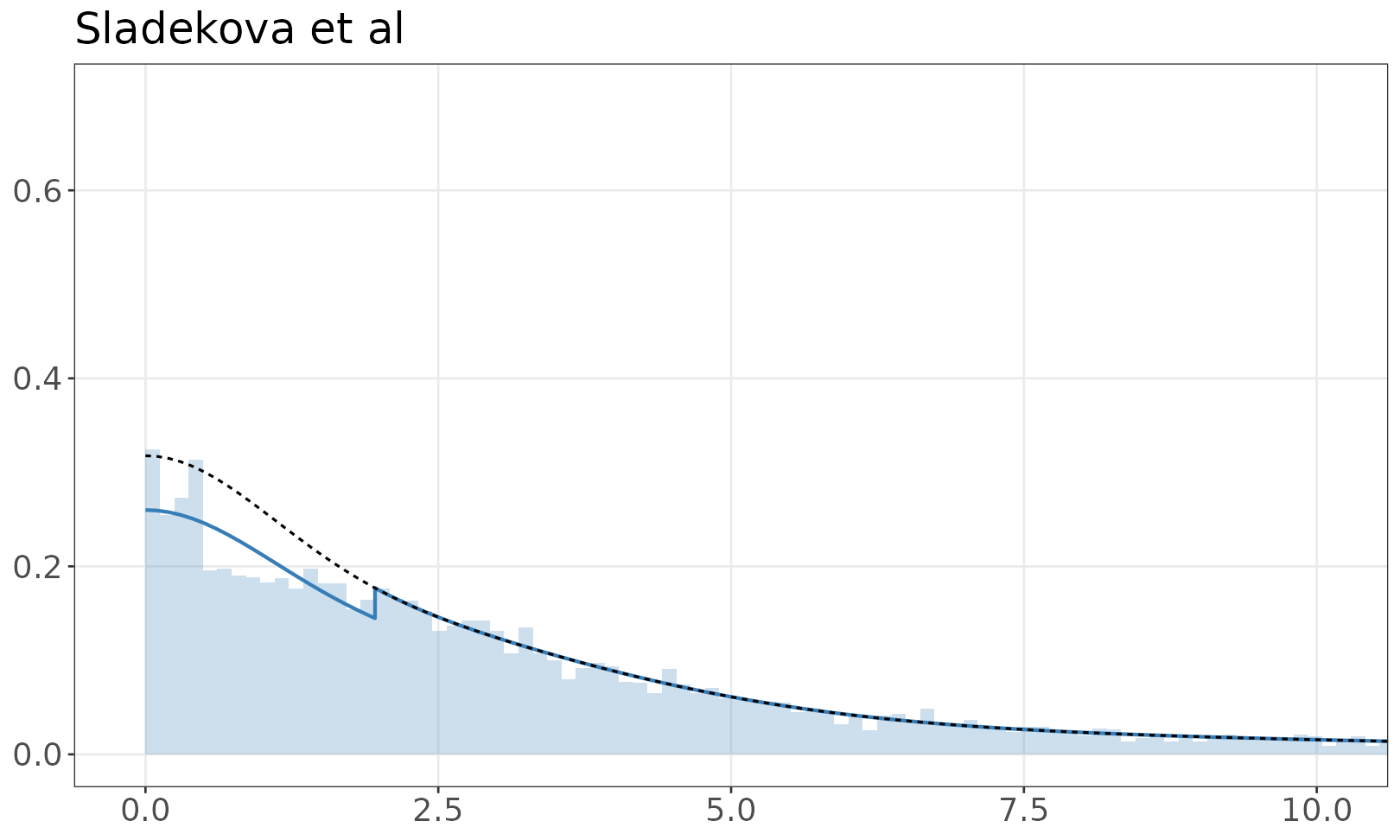
Sladekova et al. 2023
To download only this data file: Sladekova.rds (229 KB)
To download all BEAR datasets, click here.
Description
Reference: Sladekova et al. (2023).
Research question: how much do meta-analytic effect-size estimates change after applying publication-bias adjustment methods in psychology datasets?
Data availability: Data and materials are available through OSF.
Data description and source: The authors reanalysed 433 meta-analytic datasets from 90 psychology papers. BEAR represents the imported meta-analytic datasets as row-level effect sizes, with approximate study groupings.
Data processing: We use rows with available effect estimates and sampling variances. Effect sizes on the correlation scale are transformed to Fisher’s z scale, with standard errors derived from the reported variances. Signed z-values were computed as transformed effect sizes divided by their standard errors.
Study characteristics:
- Study ID: we use DOI where available, then a descriptive label and year, then the label, and finally a row-specific ID. Overall labelling of studies in this dataset is problematic.
- Meta-analysis ID: we use the source filename to distinguish meta-analyses.
- The designs of the primary studies are not classified.
Model of z-values
| Characteristic | Estimate |
|---|---|
| Probability of significance | 54% |
| Relative probability of publication for |z| < 1.96 | 0.82 |
| Successful replication for |z| > 1.96 | 83% |
| Correct sign for |z| > 1.96 | 99% |
What do these terms mean?
- Probability of significance
- The reported value is the assurance: the proportion of significant results adjusted for publication bias.
- Relative probability of publication
- The relative probability of observing a result below the |z| = 1.96 threshold rather than above it. Values below one indicate lower observation probability below the conventional two-sided significance threshold.
- Successful replication
- The probability that an exact replication has the same sign and a |z| greater than 1.96, conditional on the original result having |z| greater than 1.96.
- Correct sign
- The probability that the observed effect has the same direction as the true effect, conditional on an original result with |z| greater than 1.96.