EU Clinical Trials Register (EU CTR)
Description
Trials that reported results in the EU Clinical Trials Register, https://www.clinicaltrialsregister.eu/ (European Medicines Agency 2025).
Snapshot date: 18 January 2026
Data collection: We used the R package ctrdata (Herold 2025) to create a snapshot of EU CTR (collection = "euctr"); we downloaded only trial records with results. We stored the downloaded records in a local SQLite database and extracted a fixed set of protocol and results fields plus several fields computed by ctrdata (trial phase, sample size, and a “first primary endpoint” p-value/size derived by the package). We use only the EU CTR portion of this extraction in BEAR.
Data availability: EUCTR is publicly accessible. The EUCTR legal notice notes that publication on EUCTR does not constitute an endorsement of the information reported.
Data processing: Processing was extensive. We use only primary endpoints. We default missing CI levels to 95% and where truncation of p-values was not stated we assume equality (the latter is the case for about 15% of data). Where the data do not report whether a test is one- or two-sided, we assume two-sided. The rest of the derivation of z-values follows the Standard procedure for dealing with p-values and confidence intervals. We set year to the year of entry since completion dates were unavailable. We dropped rows only when z was missing; infinite z-values are included. We harmonise phase labels to follow the same naming convention as ClinicalTrials.gov.
Study characteristics:
Sample size:
ssis the extracted endpoint sample size (n).Study ID: we use the EudraCT trial identifier (
id).subsetrecords trial phase.The registry extract does not provide a row-level randomisation indicator, so BEAR does not classify the trial design.
Effect measures are derived from reported estimand labels; about half of these are mean differences, hazard ratios, odds ratios, risk differences, or risk ratios. Another one third have other category (in
BEAR.rdsthis is coded as “other”), and 23% have no measure.subsetrecords registry phase.
Model of z-values
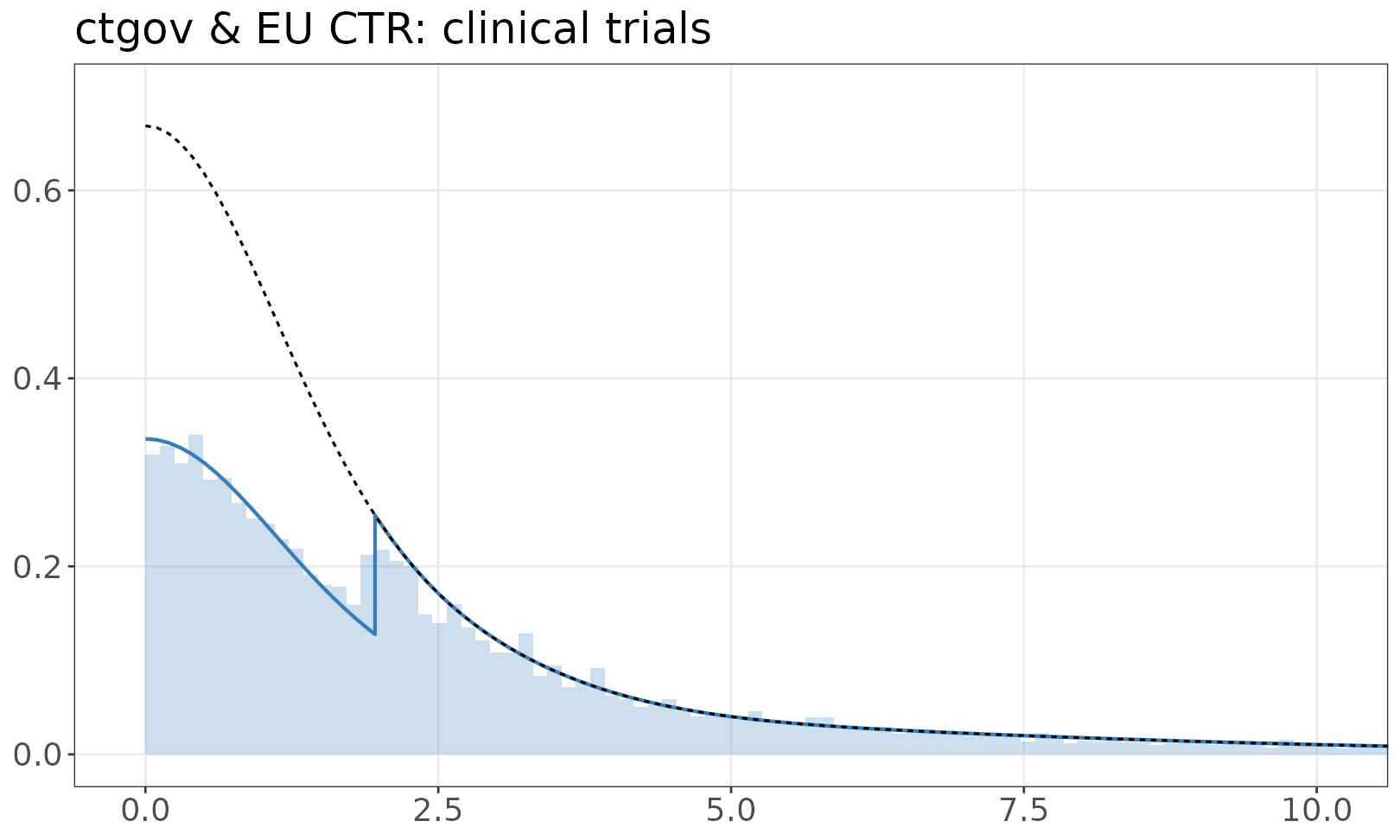
BEAR fits a single model to ClinicalTrials.gov and EU CTR because the two clinical-trials registries have similar reporting structures and z-value derivations. The plot therefore shows the combined clinical-trials fit. The companion dataset page is ClinicalTrials.gov snapshot.
| Characteristic | Estimate |
|---|---|
| Probability of significance | 33% |
| Relative probability of publication for |z| < 1.96 | 0.56 |
| Successful replication for |z| > 1.96 | 73% |
| Correct sign for |z| > 1.96 | 97% |
What do these terms mean?
- Probability of significance
- The reported value is the assurance: the proportion of significant results adjusted for publication bias.
- Relative probability of publication
- The relative probability of observing a result below the |z| = 1.96 threshold rather than above it. Values below one indicate lower observation probability below the conventional two-sided significance threshold.
- Successful replication
- The probability that an exact replication has the same sign and a |z| greater than 1.96, conditional on the original result having |z| greater than 1.96.
- Correct sign
- The probability that the observed effect has the same direction as the true effect, conditional on an original result with |z| greater than 1.96.