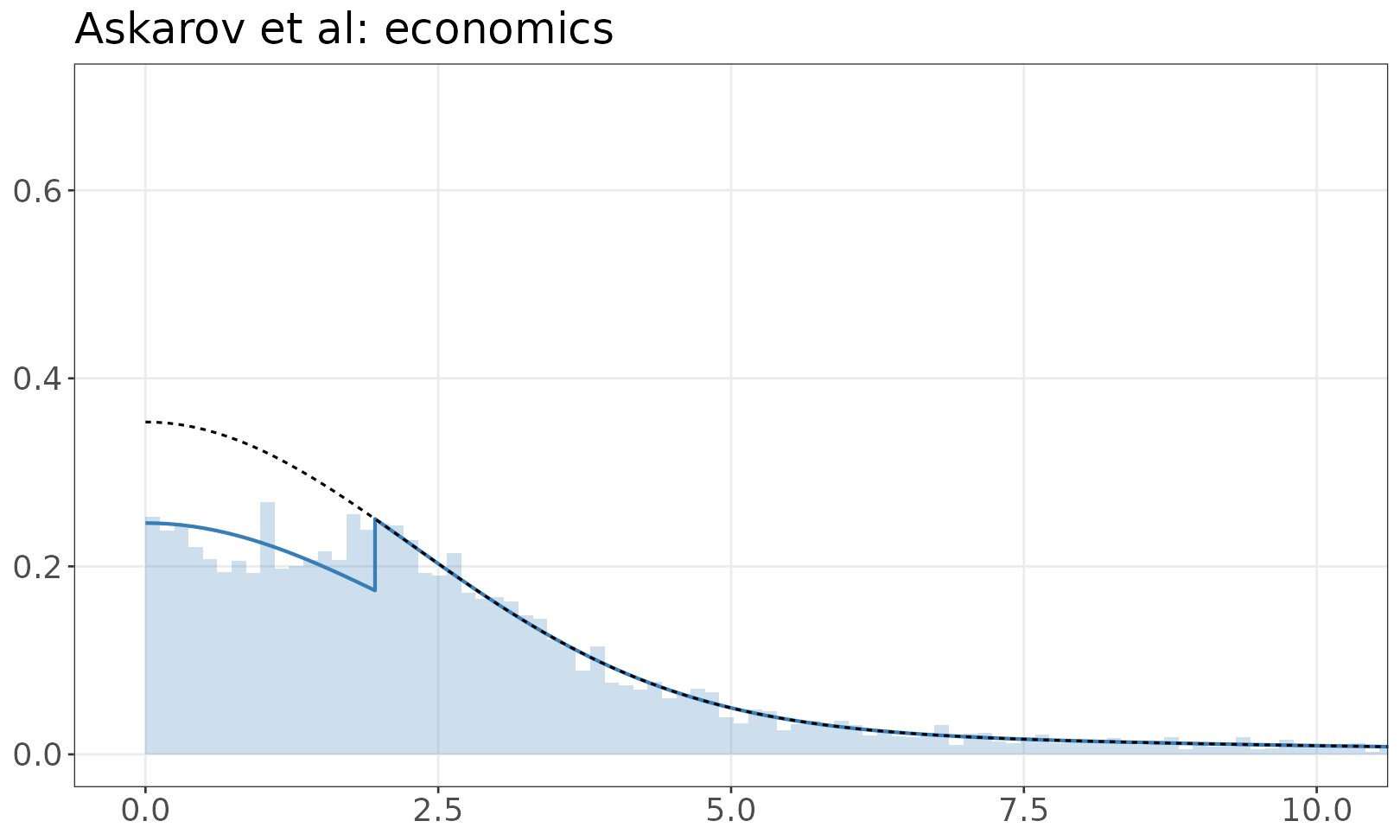
Askarov et al 2023
To download only this data file: Askarov.rds (1.2 MB)
To download all BEAR datasets, click here.
Description
Reference: Askarov et al. (2023).
Research question: Impact of mandatory data sharing on (excessive) statistical significance in economics papers
Data availability: The file Mandatory data-sharing 30 Aug 2022.dta may be downloaded from https://github.com/anthonydouc/Datasharing/blob/master/Stata/; the reproducibility package is available at https://dataverse.harvard.edu/file.xhtml?fileId=7884702&version=1.0.
Data description and source: The paper includes 64,000 economic estimates surveyed by Ioannidis et al. (2017) plus results of “searching through numerous databases, journal websites, and also an email survey of 109 authors known to have produced meta-analyses of economic topics. We cast the widest net possible to capture empirical economic estimates. Thus, some of the papers included in these meta-analyses were originally published in political science and psychology journals. Nevertheless, these meta-studies deal with economics topics.” Later they note: “we collect 166,924 parameter estimates from 345 distinct research areas, of which 20,121 were published in 24 of the leading general interest and field journals.” The paper mentions 12,521 observations from before and 2,537 from after the introduction of data-sharing policies in 24 journals; the whole reproducibility dataset has 32 journals (the authors removed some smaller ones) and 22,172 rows.
Notes: The article by Askarov et al. starts from the Ioannidis-Stanley-Doucouliagos dataset, which is also used by Arel-Bundock et al. (another dataset in BEAR). Both datasets incorporate additional data and target different fields of research, but there is likely substantial overlap between the two sets.
Data processing: We use the same source file Mandatory data-sharing 30 Aug 2022.dta (11.6 MB) as in the reproducibility package. Signed z-values were computed as reported effect sizes divided by their standard errors.
Study characteristics:
- Study ID: we use the source study identifier.
- Meta-analysis ID: we use
filename. - Topic: we use the source’s flag to distinguish macroeconomics or microeconomics/other.
- Method: The source flags experimental and mixed observational/experimental research. We label estimates with neither flag set as “not RCT, not mixed”. This category may include quasi-experimental research, which the source does not separately identify.
- We do not have access to the measure of effect size (e.g. ratio vs mean difference).
Model of z-values
| Characteristic | Estimate |
|---|---|
| Probability of significance | 48% |
| Relative probability of publication for |z| < 1.96 | 0.70 |
| Successful replication for |z| > 1.96 | 75% |
| Correct sign for |z| > 1.96 | 99% |
What do these terms mean?
- Probability of significance
- The reported value is the assurance: the proportion of significant results adjusted for publication bias.
- Relative probability of publication
- The relative probability of observing a result below the |z| = 1.96 threshold rather than above it. Values below one indicate lower observation probability below the conventional two-sided significance threshold.
- Successful replication
- The probability that an exact replication has the same sign and a |z| greater than 1.96, conditional on the original result having |z| greater than 1.96.
- Correct sign
- The probability that the observed effect has the same direction as the true effect, conditional on an original result with |z| greater than 1.96.