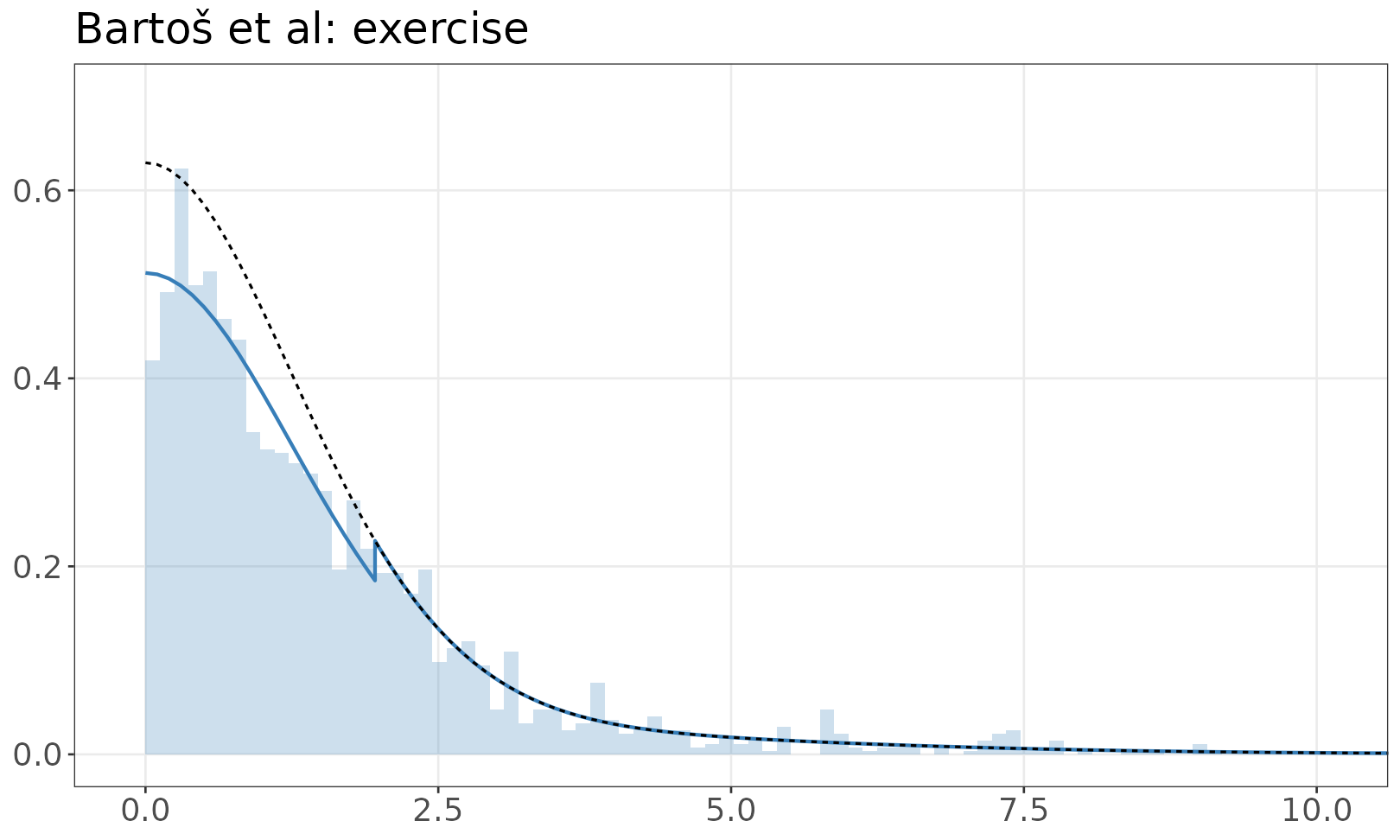
Bartoš et al. 2025
To download only this data file: Bartos.rds (83 KB)
To download all BEAR datasets, click here.
Description
Reference: Bartoš et al. (2025), which builds on another analysis, Singh et al. (2025).
Research question: What is the effect of physical exercise on cognition, memory, and executive function, with a particular focus on selective reporting and heterogeneity?
Data availability: Replication data are publicly available through PsyArXiv https://osf.io/preprints/psyarxiv/qr8e2_v1 under a Creative Commons Attribution 4.0 licence.
Data description and source: Bartoš et al. (2025) extended the systematic review and meta-meta-analysis by Singh et al. (2025). Singh et al. compiled a set of peer-reviewed systematic reviews with meta-analyses of randomised controlled trials that evaluated exercise effects on general cognition, memory, or executive function. Bartoš et al. extracted study-level effect sizes and standard errors, or information needed to compute them, from study tables, forest plots, and online supplementary materials. Their analysis included 2,239 effect-size estimates from 215 meta-analyses.
Data processing: Z-values were computed as the effect size divided by its reported standard error. No filtering or recoding beyond variable renaming was required.
Study characteristics:
- We do not have study year; we do have the publication year for each source meta-analysis, but choose not to use it.
- Study ID: we use
idfrom original data, which is unique to each row; there is unfortunately no data to distinguish which data come from the same study and further work on this will be needed. - Meta-analysis ID: we use the source meta-analysis label in the original data,
meta_id. - Topic: we use categories from original data: “executive function”, “general cognition” or “memory”.
- All studies are RCTs.
- The reported measures are standardised mean differences; in the dataset we also include a flag to differentiate Hedges’ g from Cohen’s d.
Model of z-values
| Characteristic | Estimate |
|---|---|
| Probability of significance | 23% |
| Relative probability of publication for |z| < 1.96 | 0.81 |
| Successful replication for |z| > 1.96 | 54% |
| Correct sign for |z| > 1.96 | 96% |
What do these terms mean?
- Probability of significance
- The reported value is the assurance: the proportion of significant results adjusted for publication bias.
- Relative probability of publication
- The relative probability of observing a result below the |z| = 1.96 threshold rather than above it. Values below one indicate lower observation probability below the conventional two-sided significance threshold.
- Successful replication
- The probability that an exact replication has the same sign and a |z| greater than 1.96, conditional on the original result having |z| greater than 1.96.
- Correct sign
- The probability that the observed effect has the same direction as the true effect, conditional on an original result with |z| greater than 1.96.