Many Labs 2
To download only this data file: ManyLabs2.rds (52 KB)
To download all BEAR datasets, click here.
Description
Reference: Klein et al. (2018).
Snapshot date: January 2026
Research question: replications of 28 classic and contemporary effects in psychology, with the same effects tested across many samples and research sites.
Data availability: The authors make their replication package available through OSF (https://osf.io/fanre/). We use the Many Labs 2 analyses included in the paper’s key table and the replication results aggregated by site from the public data package.
Data processing: We use the 28 preregistered analyses included in the paper. Each row is a site-level replication estimate for one analysis, so the dataset has many more rows than analyses. We use the Many Labs 2 analysis identifier as metaid. Thus, a single finding such as Kay.1 contributes one BEAR row for each sample/site estimate, rather than one row for each alternative statistical scale reported for the same sample. The additional grouping variable distinguishes analyses designated as primary or secondary by the original authors.
The effect-size measure is the correlation scale. We used the reported r estimate as b, its reported variance to compute se where available, and then computed z = b / se. For two analyses where the variance of r was not available but a signed equivalent test statistic was available, we used that statistic as z and derived the implied standard error. Original-study effects were matched by analysis where available and stored separately from the replication estimates.
Study characteristics:
Study ID: we combine
study.sourceandsource.Filenameto identify a replication site/sample.Meta-analysis ID: we use
analysis.name.subsetrecords the authors’ primary or secondary analysis classification.The source contains multi-site replications of psychology experiments; BEAR does not classify randomisation for individual rows.
The effect measure is the correlation scale.
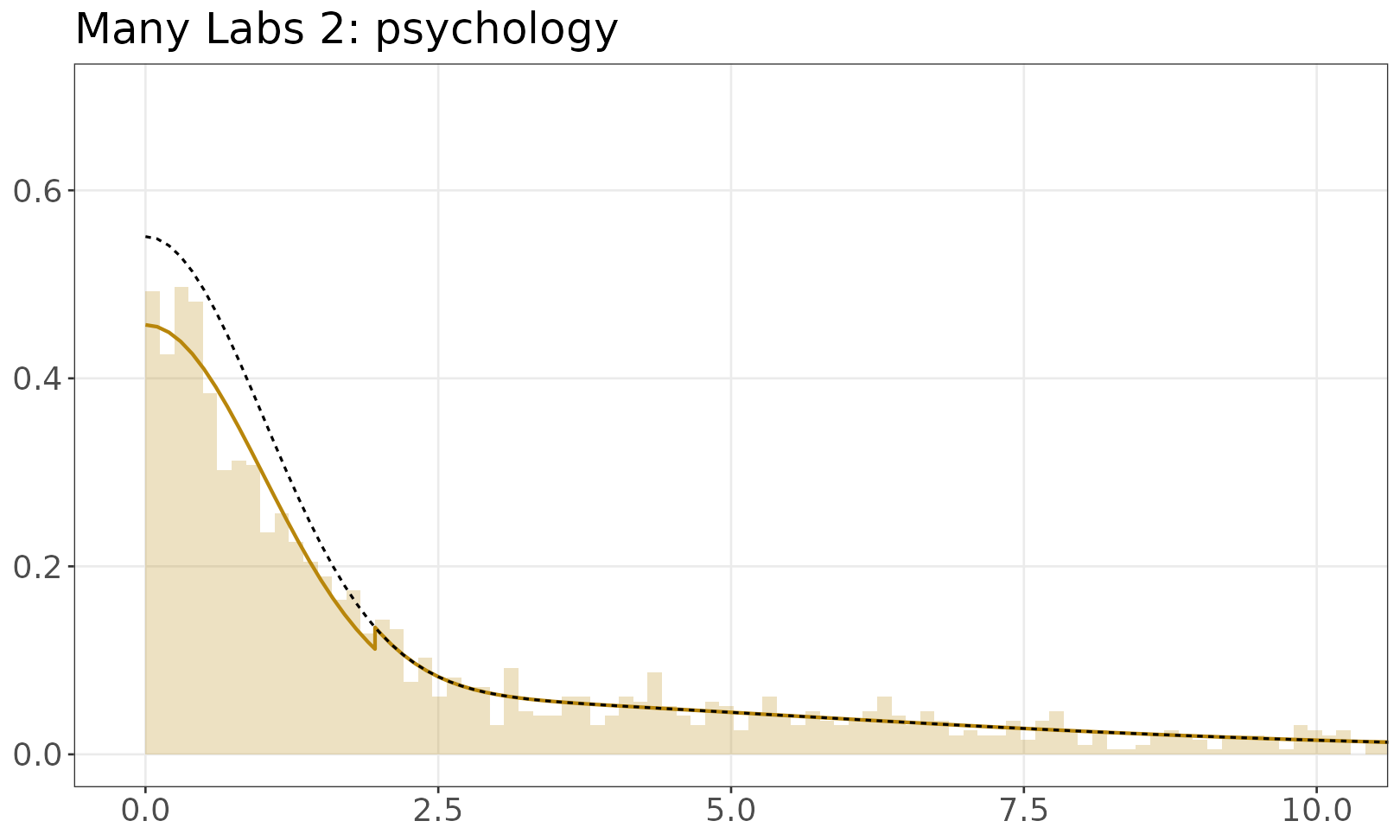
Model of z-values
| Characteristic | Estimate |
|---|---|
| Probability of significance | 37% |
| Relative probability of publication for |z| < 1.96 | 0.83 |
| Successful replication for |z| > 1.96 | 84% |
| Correct sign for |z| > 1.96 | 96% |
What do these terms mean?
- Probability of significance
- The reported value is the assurance: the proportion of significant results adjusted for publication bias.
- Relative probability of publication
- The relative probability of observing a result below the |z| = 1.96 threshold rather than above it. Values below one indicate lower observation probability below the conventional two-sided significance threshold.
- Successful replication
- The probability that an exact replication has the same sign and a |z| greater than 1.96, conditional on the original result having |z| greater than 1.96.
- Correct sign
- The probability that the observed effect has the same direction as the true effect, conditional on an original result with |z| greater than 1.96.